In short
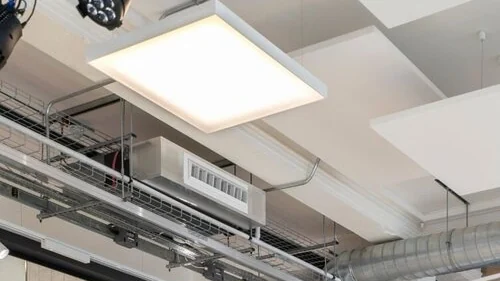
Recessed lighting needs a ceiling void deep enough for the fitting, driver and clearance from services; check product depths early against the reflected ceiling plan.

Ceiling void depth is the first question for any recessed scheme. Get it wrong and fittings clash with ducts, sprinklers or structure.
What takes up space
- The fitting body
- The driver, if mounted on top
- Clearance for heat dissipation
- Cables, connectors and access
How to check
- Confirm the void from the structural and services drawings
- Overlay fitting positions on the reflected ceiling plan
- Check every run of recessed linear along its full length
- Allow for beams, ducts and sprinkler mains
When the void is shallow
Slim profiles and low-profile downlights help, and remote drivers can sit elsewhere in the void. If there is no void at all, consider surface-mounted or suspended lighting instead.
Thermal management
LEDs and drivers need to dissipate heat. Avoid covering fittings with insulation unless they are rated for it.
Further reading at 299 Lighting
Next steps on recessedlighting.co.uk
Planning a recessed scheme?
Send us your reflected ceiling plan. We'll come back with a product shortlist, ceiling cut-out details and lighting calculations.
Start a project →Frequently asked questions
How deep does a ceiling void need to be for downlights?
It depends on the product. Check the fitting height plus driver and clearance, and confirm against services drawings.
What if there is no ceiling void?
Use surface-mounted or suspended lighting, or create a bulkhead or raft to house recessed fittings.